Sunday, October 23, 2011

The Geography of Sish

These pictures are from a few different walks around Shishmaref. Shish is an island that is more long than wide. It's short going east to west and long going north to south. On the west side it looks to the Chukchi Sea north of the Bering Strait and on the east you can look out over the "lagoon." Across the lagoon you can see the main land. These pictures are mostly along the long part of the island running north to south. South goes towards the dump. 

This first walk is towards the south.
The sea wall that was put up to keep the island from eroding into the sea. In other places the sea wall is much larger and some places it is nonexistent.

You can see how close the sea wall is to some of the housing. This building is teacher housing and is part of the old school.

I do not remember what these racks are called but they use them to hang animals out to "dry." The child's wagon made a cool picture I thought.

You can see some of the ribs and things drying. The salt from the ocean in the air helps preserve the meat.

Just some old broken down buildings. This one has a Winnie-the-pooh plush on the door.

If you get close enough you can see the little blue sign that says, "police."

A boat frame. As we walk around we sometimes see people building boats. It is just amazing to us how they craft them from hand out of scratch.

Yup.

Haha. I don't think they actually use this chair but we thought it was a funny picture to take.

This is the post office! We check the mail religiously! We believe the Post master lives upstairs and the post office is on the bottom story. If we walked around to the other side you could see our house.

While walking around we ran into one of the other teachers who said she was going over to watch this person cut up some fish so we tagged along. She is originally from Shishmaref but now lives in the lower 48 with her husband and family. She comes home ever summer with her kids so they know the culture and visit their family.

A close up. The tool she is using in called an ulu.
 This is now the North side of the island.
Look how thick the insulation for the winter!

The old runway and the people we were walking with.

These dogs will be used for dog mushing! They stay outside all year long but all the dogs are tied up.

Just a pretty picture : )

Mike walking along the Chukchi Sea.

Looking back at Shishmaref.

We found this old decomposing walrus!

The last tree of Shishmaref.

Note: This is not a tree but a stick stuck in the sand. There are no trees in Shishmaref.

Our Shadows!

Erick, from Florida who was still getting used to the cold, Lani, from Oregon, and Amy, from Ohio. They are all teachers and we were exploring together.

Lisa and Mike on the sound. This is the very tip of the north of the island.

Walking back along the "lagoon" side. You can see Ear Mountain which is on the mainland.

Most of the island is just sand so it was nice to see some flowers.

Walking back through the marsh as a short cut but it got too marshy so we had to go back along the coast.


All of the boats in the setting sun.


We came across this caribou that someone had shot.


Mike feeling the antlers. There is a kind of fur on them which makes them smooth.

The old air strip, it has eroded right into the water. The new air strip now runs north to south, the longer way the island goes, but is not as ideal for landing on with the way the wind blows.

This basketball hoop is right on the old air strip.

Notice the cute little dog on the steps!

We don't know how this got there! We have learned, that since it is so difficult to get things on the island, when something stops working, such as this airplane, they don't take it to the dump or get rid of it because the parts may be able to be used for something else. Which makes sense but then you end of with a lot of old things sitting in random places.

The setting sun.

This building here is the church.


Hence, the random things sitting everywhere! Note: Ear mountain in the background.

As we were walking we had to be tourists when we saw this polar bear fur hanging out. Yes, we asked permission before we just started taking pictures.


Now you have had a tour of the outskirts of Shishmaref! It is Mike's job to take you on the tour of the dump and we will attempt to get some more pictures inside the village for you to view in the near future!

Saturday, October 15, 2011

The Polar Bear Plunge

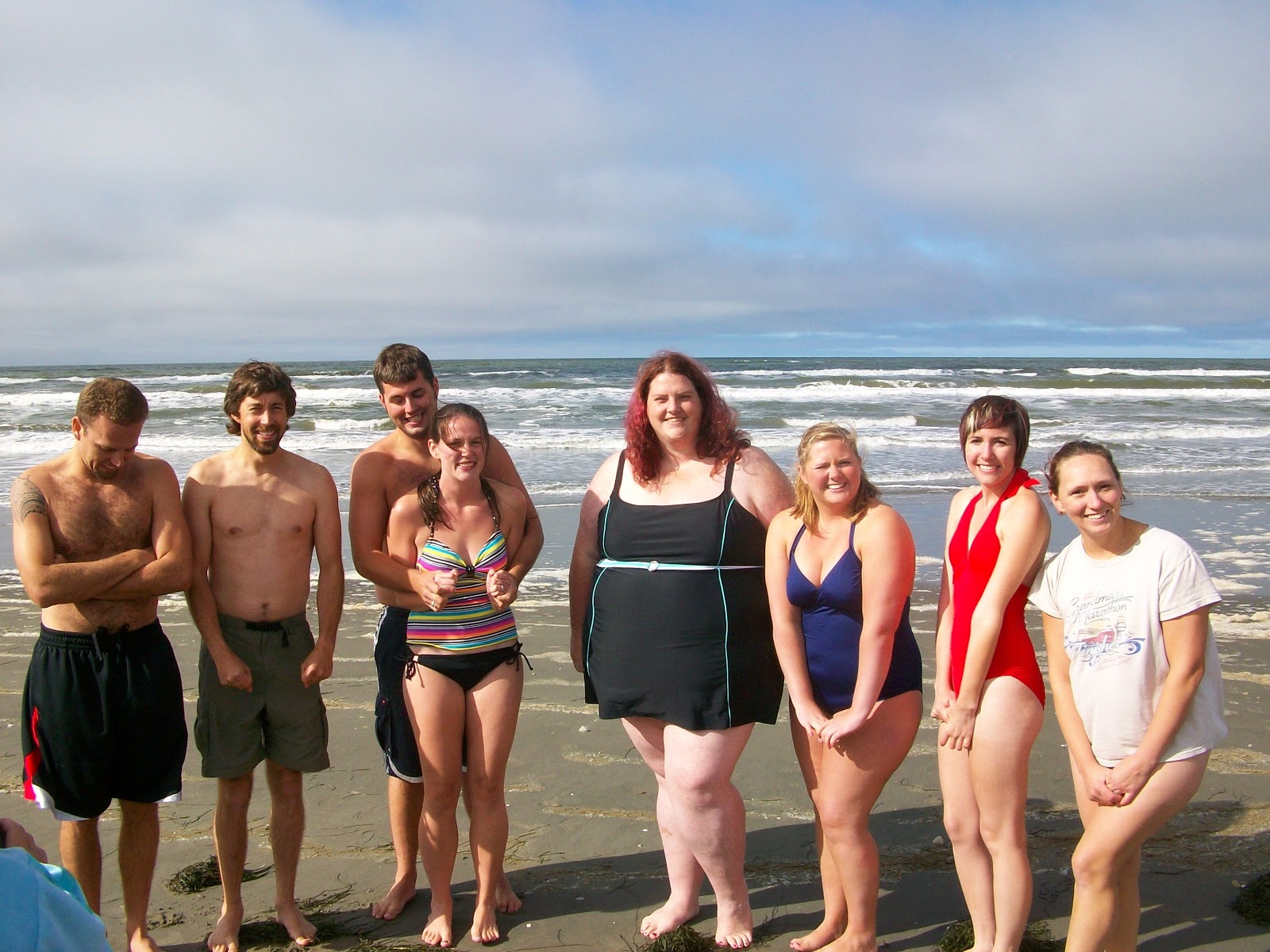
The before shot. Nice and warm and dry. From left to right: Colleen, Erick, Lani, Lisa, Mike, Amy, Pastor's Friend (I don't remember his name : / )
The week before school, Amy knocked on our door, "Are you ready for the polar bear plunge?" So Mike and I put on our "just in case swimsuits" and prepared for the cold of the Chukchi sea.
Another before shot, when we are at the beach and about to take the plunge. Mike is nervous.
 There are apparently rules for the plunge. In order for it to count you have to run out at least waist high, completely submerge under water and take at least a few strokes before you run back out. Our designated photographer took this photo. I may be way in front of the rest of people, but I would like to point out that Mike and Erick, the boys, were the first ones out.


Running out of the sea
 The coldest part of the whole adventure was the ride there. We rode in the back of a pick up truck, dreading the cold ride back. When running into the sea, it is as cold as you think it will be, however once your head is underwater you feel at peace and warm, the run back out of the sea just feels warmer and warmer and when standing on the ocean you don't feel as cold as you did before you went in the water. Maybe your body is just at shock and doesn't know how cold it is.
The after shot. Not quite a honeymoon in Punta Cana, but we did get a little sun in!

Another after shot. It's not really that cold, you just feel like you should be : )

After shot of the whole group.

The worst part was trying to get the sand off, because you knew you would be cold on the way back so you wanted to put socks and shoes and clothes on but not with sand in them!
 We drove very far from town before Colleen and Amy decided we were at the perfect part of the beach, about a 20 minute ride. The farther we went, the more we first timers were concerned we would be frostbitten on the way back.

Some high schoolers on a four wheeler decided to follow us down the beach to watch.
 Surprisingly the ride home actually felt warmer than the ride there!
Lani and Mike on the way back. We made it safe and sound and no one caught a cold : )
Great way to end our summer vacation before beginning or first real teaching jobs!

Saturday, September 17, 2011

How The Water Works

When we got the call to teach in Alaska, the first thing they did was ask if we were still interested in coming to Alaska, the second thing they did was tell us that there was no running water in the housing we would be in if we were offered the job. "With that being said are you still interested in taking the job?" 

Really in the grand scheme of decision making, the fact that they had no running water didn't weigh heavy with us. The people here live with it, all the teacher's live with it. It is what they know.

Not that I enjoy not having running water, but I do enjoy knowing that I am not wasting water. (I also feel a little Laura Ingelsish!) The students and everyone here is very aware of the water situation. When my second graders wash their hands they turn the water off when they get soap and back on to rinse. When someone has the water on for a long time, the others will turn around and tell them to turn the water off, "we can't waste it!"
Families here can go to the Washateria to shower and wash laundry... to wash and dry a load of laundry is $16 so you can imagine that it isn't done extremely often. In the elementary school every class has a certain time one day a week where the children are allowed to shower in school. Parents come in to volunteer supervising and thus get a free shower as well. I have only had one shower day so far but the kids were so excited about it.

I don't know about everyone but Mike and I, and most of the houses I have seen, have what is called a cistern. A cistern is basically I giant plastic barrel that holds water. Our cistern holds 300 gallons of water. To get water into your cistern you are supposed to get a truck, take a sort of travel cistern, drive to the Washateria, use a hose to get water from the Washateria (I think it's about $4 for 50 gallons), roll the hose back up, drive to your house, and pump the water into your cistern, then take the cistern and truck back.
Mike and I are lucky; since we live right across from the school we can attach a hose to the school and run it straight into our house. Our neighbor has a hose on his porch and he lets us borrow it and the key to the water. It takes about 45 minutes to fill our cistern.

The water runs from the cistern through a water pump and pumps it into pipes so it is basically like we have running water for sinks and showers. We are very aware of how much water we are using. For example, it takes about 15 gallons of water for a 15 minute shower. We use minimum water when washing dishes. It feels like we have running water, we just have to fill the tank every 2 - 3 weeks. (We met someone who said they will fill the cistern any time for $15, which we might take up when it is 40 below!)

The biggest difference in our plumbing life is that we have no flush toilet. We have what is called a honey bucket. You kind of get used to not using the toilet at anyone else house and no one really asks at our house (except the kids, who don't care haha but we still don't let them) "I have to use the bathroom!" "Well, you can't go here, you have to go home..." "Never mind!"

The bathroom doesn't have a heating vent so it is very cold but it helps it not smell. Basically, a honey bucket, is a bucket... with a garbage bag in it... and you put a plywood box with a toilet seat on it around it. About once a week, if it's getting full, or starts to really stink, we empty it. (I know this is gross, but you're only reading it! We live it!)
Mike and I had a lot of debates/discussions about how the emptying of the honey bucket should go. I was all for him doing it but we found a happy medium; I pick the plywood box up and take it off the bucket and tie the garbage bags (one bag wasn't enough, two seems to do the trick. we buy extra durable, odor blocker bags.) then carry the bucket from the bathroom, through the living room, and into the arctic entrance (I do not know how to spell it but the room is called a kunituk, I will explain this later) Mike stands in the doorway preparing to take the bucket outside. He takes the bucket to this bin sort of thing, which is about 15 feet from our doorway, where he dumps the bag with our business into it. When ever this bin gets full we call the city and they come and empty it. Thank goodness that's not my job! The first part of this process makes Mike nauseous, while the second part makes me nauseous so it evens out.

After our business is out of the house, the smell is not, so we usually leave the windows and door open and light a candle. I then usually spray the inside of the bucket with some kind of bleach cleaner just for good measure, wait for it to dry, load the garbage bags, put it back in place, and we're good to go!

The school has gym showers and washers and dryers that we are allowed to use. At first we tried taking showers at the school to preserve our water but we then decided that taking all our shower stuff, getting dressed, walking through the sand, showering, and walking back was more work than just filling our cistern when it was empty. We do do our laundry at the school though, our night is Tuesdays from 4:00 to 8:00 PM! Oh Boy!

The honey bucket, we now have a nice shower curtain for the shower and bathmat for the floor!


Don't worry! This picture was taken before we used the honey bucket even once. You can see it is ready to go, loaded with the garbage bags.

You can see our water cistern in our  kunituk here. This is one of our frequent visitors, she is in 4th grade and came over when we were getting water and decided she wanted to help.

Thank you for your help!

This is the view from the top looking down into the cistern as it is being filled. You can see all the sand on the bottom. The sand pretty much just sits there but we still filter our drinking water just in case!

The hose running from our house to the school. Mike is up there turning the water on, you can see all the kiddies who were excited we were out and followed him up to see what he was doing.

Soooooo, we learned there is a hole towards the top of the cistern that once the water gets that high starts to leak... apparently the duct tape that was over the hole doesn't hold the water... 

Mike ringing out the water from the water on the floor from the leaking cistern. Once we realize it was leaking I started doing dishes ASAP. We figured that if the water was going to come out we should try to use some of it up on something useful.